Showing posts with label French drain. Show all posts

Wednesday, November 30, 2016

Which Pipe is Best?

I need to get my gutter water away from my house. Which kind of pipe should I use?

Great question! There's a short answer and a long answer.

The Short Answer
There are two main types of pipe used in residential settings to transfer rain water. Corrugated pipe and PVC pipe. Corrugated pipe is the cheapest, easiest, and most common option. But we advise people against using corrugated pipe to transfer water underground. (*Note: This article deals with transferring water with a solid pipe, not constructing a French drain. That's another topic for another day!)

The Long Answer

Corrugated Pipe: The term "corrugated" applies to any material that has alternating ridges and
4" Corrugated Pipe
grooves. You've probably seen a corrugated metal roof or even corrugated cardboard. But in this case, we are referring to corrugated plastic. The most common corrugated pipe used in residential settings is black with a 4" diameter.

Pros of Corrugated Pipe:
  • Less expensive than other options.
  • Can be easily bent due to the corrugated nature. It can almost make a 90 degree bend in a tight space without using any additional fittings.
  • Is light weight and easy to work with.
  • Readily available at your local home improvement store.

Cons of Corrugated Pipe:


  • Debris and sediment has a tendency to get caught and accumulate in the ridges, therefore slowing down water flow. 
  • The pipe walls are thin and soft, and they can easily be damaged.
  • If the pipe is exposed above ground, it is easily damaged by weed trimmers, lawn mowers, foot traffic, and pets.
  • If the pipe is buried below ground, the pipe wall can be penetrated by roots. Even shrub roots can penetrate the wall in search of water, causing up to 100% blockage. 
PVC Pipe: PVC stands for Polyvinyl Chloride, and is commonly used as a more durable and less expensive alternative to traditional materials such as metal or terra cotta. PVC can be produced in many colors, sizes, lengths, and thicknesses. It is often used for sewer and plumbing, but it is also a
4" PVC Pipe
great product for many yard drainage situations. 

Pros of PVC Pipe:
  • It is much more durable than corrugated. Roots will not penetrate the walls.
  • The walls of the pipe are smooth so there are no ridges to slow down water flow or to catch debris.
  • Clean-outs can be installed for system maintenance.  
  • For these reasons, it has a much longer life span than corrugated pipe.
Cons of PVC Pipe:
  • More expensive to purchase than corrugated pipe.
  • More labor-intensive to install.
  • Due to it's rigid nature, fittings must be used to bend or turn the pipe. Fittings are commonly glued together using a special PVC cement. 
  • Can be confusing to work with due to the various sizes and grades available on the market. 
Conclusion
Although PVC pipe is more expensive and more difficult to install, it is well worth the extra investment in the long run. A homeowner that wants to do it right the first time, and not have to come back and fix the problem again in a few years, should strongly consider installing PVC pipe to transfer water away from the home.  Visit our website to learn more. 

Monday, February 17, 2014

What do Las Vegas and Your Wintertime Yard have in Common?

I doubt your yard looks like this.
I doubt you have neon lights, slot machines, or Elvis impersonators performing in your yard. But it is true that what happens in your wintertime yard, stays in your yard.

What do I mean by that? Hang with me. When it precipitates, the water in your yard has three options:

  1. Seep into the soil. The rate at which water perks into your soil depends on your soil type. Sandy soil drains better than red clay, and rad clay drain better than blue clay. 
  2. Run off to another location. Lots with more slope will have less standing water due to run off. 
  3. Evaporate. Evaporation is caused by heat and happens faster in direct sunlight. 
So, in the winter what happens in your yard stays in your yard - due to a lack of evaporation. Have you noticed that in the winter months, particularly in shady areas, your yard tends to be muddier and soggier. If you would like to get rid of this, your best bet may be an underground drainage system, such as a French drain

Monday, February 3, 2014

Two Common Problems - One Common Culprit

Down spout erosion. Standing water in foreground.
The culprit: water.

The problems: erosion and flooding.

This great photo (submitted by a desperate homeowner in Concord, NC) illustrates two different but related water problems. Rain water gushes out of this downspout causing erosion. The gutter water, as well as water from other parts of the yard, gather in this low spot near the driveway to create nice wadding pool.

The result is dead grass, an unusable yard, and a breeding ground for mosquitoes.

This perfect storm can be resolved, however. First of all, in a situation like this it is good to extend the gutter underground to a more desirable location such as a ditch, a storm drain, or a lesser used part of the yard. Next an underground French drain may be recommended to collect water from this area and move it to another location. Finally, regrading the area serve as a way to move surface water to where you want it to go.

This type of project usually requires an excavator and may be too involved for the average DIY'er. If you have erosion or standing water contact Green Frog Waterproofing for a Free Estimate.

Thursday, January 2, 2014

6 Ways to Keep your Crawl Space Dry

1. Keep outside water out
Image
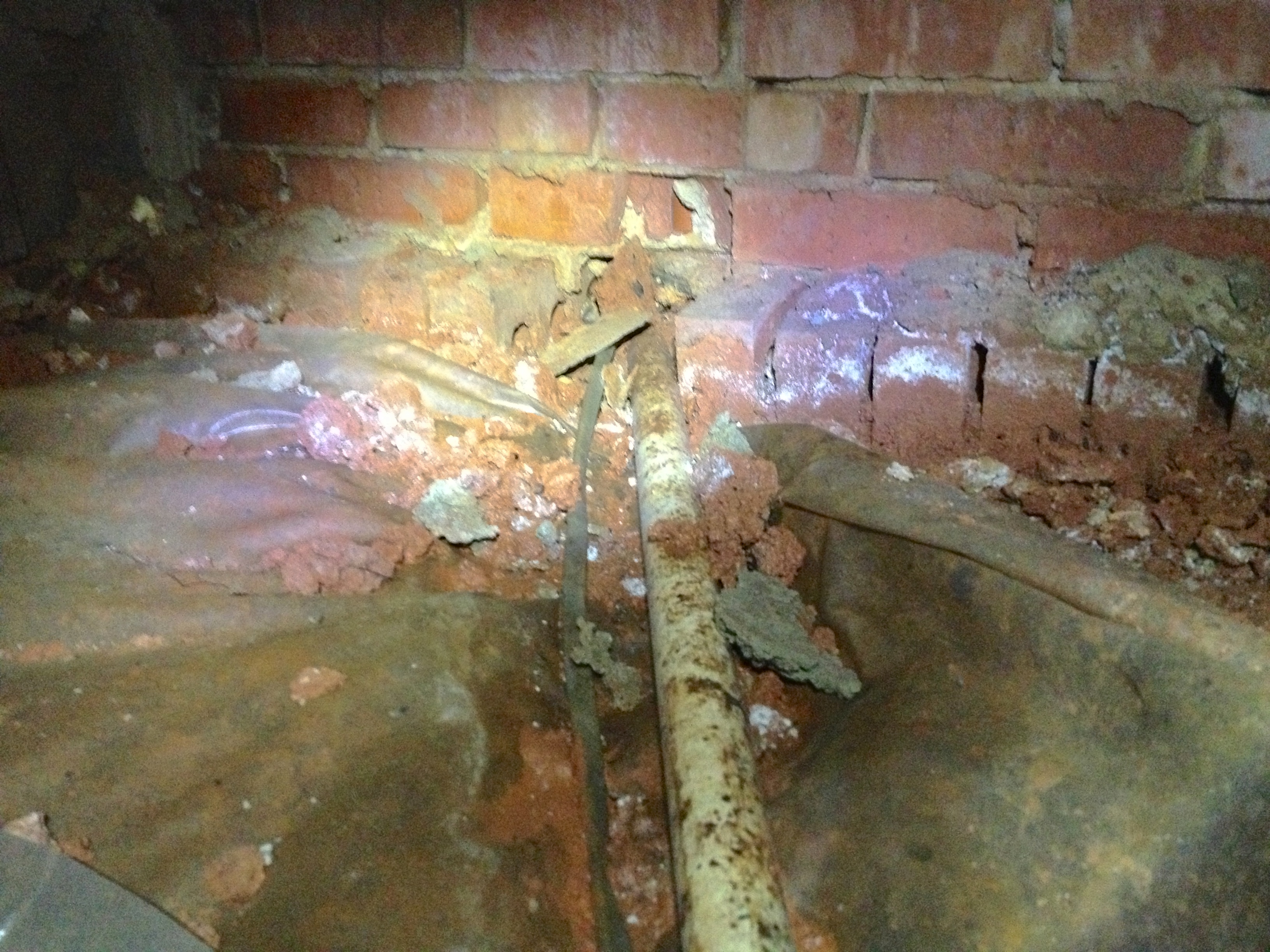
An open plumbing penetration is allowing water and debris to enter crawl space.
A few steps should be taken to prevent water from the outside of your home from having an easy opportunity to make it’s way into your crawl space. Extend your gutters (above or below ground) away from your foundation. Make sure that you have at least 5% grade falling away from your foundation so that water can easily flow away from your home. Seal below ground penetrations in your foundation wall that were created during the construction process. A thorough inspection by our Moisture Intrusion Technicians can reveal these penetrations.
2. Adequate vapor barrier
The floor of your crawl space should be 100% covered with a minimum 6 Mil plastic barrier. This barrier can be upgraded by installing a thicker plastic and/or taping the seams. A thicker plastic can add to efficiency and longevity of your vapor barrier.
3. Waterproof the outside of your home
You can prevent water from seeping through the foundation walls by waterproofing the exterior surface of your crawl space walls. This process should be performed by a professional as it involves excavating the earth beside the wall, cleaning the wall, applying a waterproof membrane, and possibly installing a drain beside the footer.
4. Install a french drain and sump pump
It is not always ideal to excavate and waterproof the exterior of the home. In this case the water can be controlled by installing an interior French drain that moves the water out of the crawl space. Depending on the terrain of your yard, a French drain may also need to be installed in conjunction with a sump pump
5. Install a dehumidifier
Image
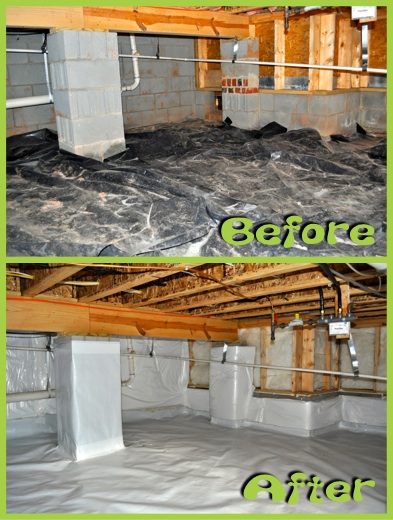
A sealed crawl space before and after.
dehumidifier can keep the humidity level low and reduce the chances of mold, but keep in mind that you will also need to seal any possible openings that can allow humid air to enter. Otherwise you will be unsuccessfully attempting to dehumidify your neighborhood! A few common culprits are the crawl vents, lack of a tight seal on the crawl door, and small holes in the masonry wall around wires, cables, and plumbing lines.
6. Seal (encapsulate) the entire crawl space
The best case scenario for maintaining an ideal humidity level in your crawl space is to seal or encapsulate the crawl space. A crawl space that is sealed properly will not allow any outside humidity to enter the crawl, creating a clean and dry environment. A sealed crawl space improves your home’s indoor air quality, improves the efficiency of your HVAC system, as well as creates an ideal environment for storage.

Tuesday, December 17, 2013

What is a French Drain and what does it have to do with France?

The phrase French Drain is heard quite often … on your favorite how-to TV show, in your local home improvement store, and in conversations in the yard with your neighbor. But I regularly hear the phrase “French Drain” used incorrectly. A French Drain is not to be confused with an underground gutter extension or a simple solid pipe used for relocating water from one location to another.

So, what is a French Drain?

French Drain install in progress
A French Drain can vary in size and materials used, but the essence of a French Drain contains these components: a trench, a perforated pipe (as opposed to a solid pipe), drainage rock, and a sediment filter. A french drain is commonly used to solve water related issues both on the interior and the exterior of a home, office, barn, shed, or other structure.

Interior applications

A French Drain is used primarily in two interior environments: basements and crawl spaces. These internal applications are methods of water control, not to be confused with waterproofing. Read this article to learn more about the differences between water control and water proofing.

Exterior applications

A French Drain is also used primarily in two external environments: yard drainage and foundation drains. A French Drain in your yard gives water an underground path to follow to get to where you want it to go, therefore controlling flooding, washout, erosion, or standing water problems. A French drain at the foundation of a structure will catch water near your building’s foundation and move it away without giving it an opportunity to enter your basement or crawlspace. A footer drain is usually installed along with adequate waterproofing of the foundation wall.

Was does a French Drain have to do with France?

Well, nothing really! The term French Drain was coined by an American named Henry French. French was an agriculturalist, inventor, lawyer, and author in Massachusetts in the 1800’s.

Do I need a French Drain?

If you have standing water or erosion under, in, or around your house, a French Drain could be a good solution for you. But a French Drain is not the answer to every water problem. Our Moisture Intrusion Specialists at Green Frog Waterproofing would be happy to inspect your property for free and give you a custom solution to resolving your water problem. Click here to request an inspection.

If you would like to learn more about French Drains, click here to view some informative articles on our website.